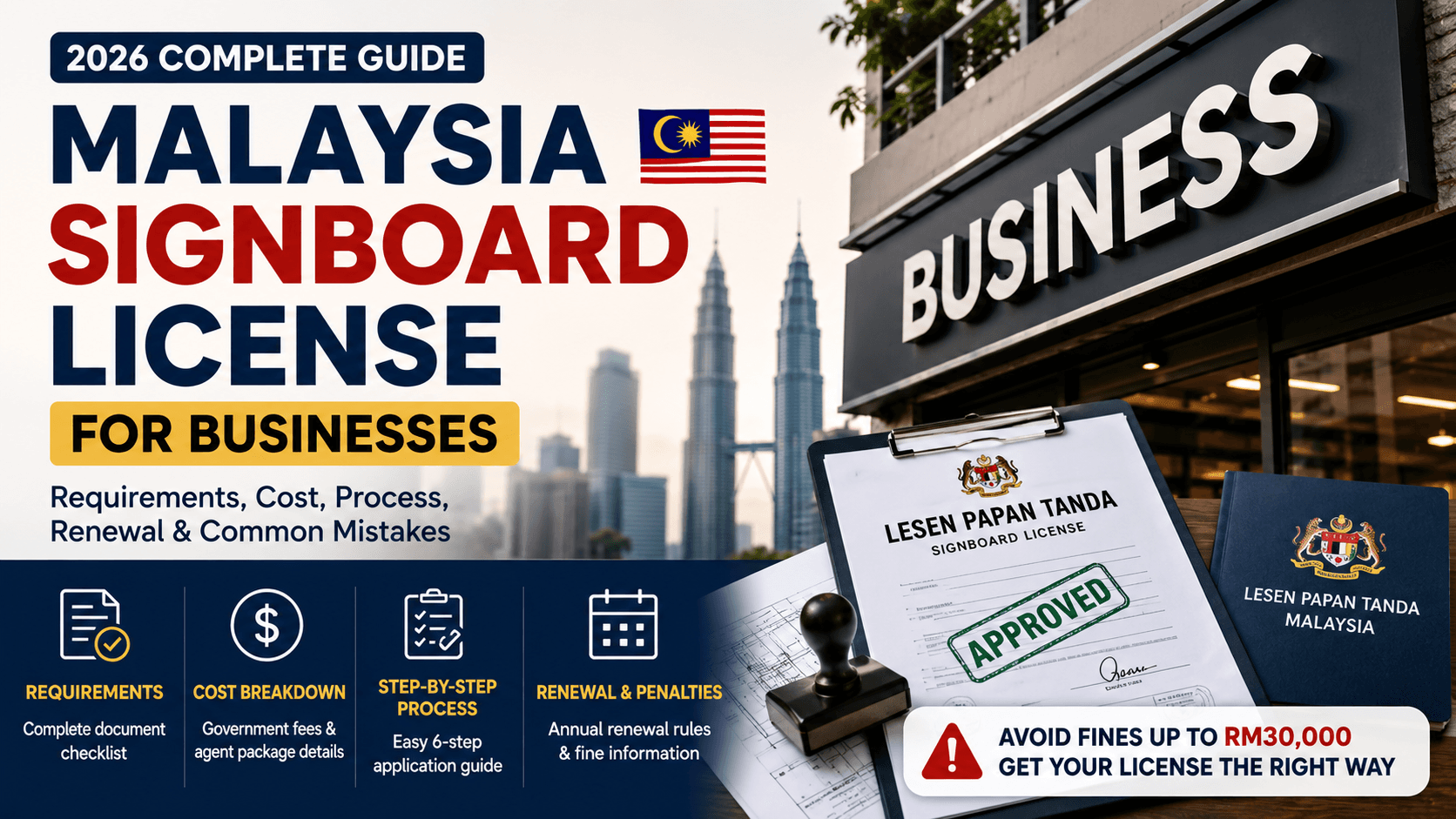
Malaysia Signboard License Complete Guide for Businesses
April 2, 2026
What is a Signboard License in Malaysia
A signboard license — or lesen papan tanda in Malay is an official approval from your local city council that allows you to legally install and display a business signboard outside your premises.
It is not optional. Every physical business operating in Malaysia is legally required to obtain one before installing any signage.
A signboard is often the first thing customers notice before they even walk into your business. It is your brand's first impression and, under Malaysian law, it must go through a formal approval process to ensure safety, language compliance, and visual order in public spaces.
At HC Creative Hub, we have helped businesses across Kuala Lumpur and Selangor navigate this process since 2013. One of the most common things we hear from new business owners is: "I did not know I needed a license before installing." Getting this right from the start saves you time, money, and the stress of forced removal.
Who Needs a Signboard License in Malaysia
If you operate a physical business premises, you need a signboard license. This applies regardless of business structure sole proprietorship, partnership, or Sdn Bhd.
This includes:
- Retail shops and boutiques
- Restaurants, cafes, and food courts
- Offices and co-working spaces
- Clinics, salons, and wellness centres
- Showrooms and franchise businesses
- Schools and educational centres
Even if you plan to install more than one signboard at the same premises, each sign may require separate approval depending on its type, size, and position.
Types of Signboards That Require a License
It is worth knowing that DBKL officially recognises six categories of signage, each requiring its own license:
Premise signboards — the main shop sign directly outside your business
Temporary displays — banners and short-term promotional signs
Outdoor advertisements — large-format ads not tied to a specific premise
Lamp post advertisements
Banners
Balloons and special format displays
This guide focuses on premise signboards — the category most business owners need. Here are the common types that require approval:
3D and Acrylic Signboards
Whether it is a 3D frontlit signboard with LED illumination or a clean 3D non-light acrylic sign, council approval is required before installation. Size, placement, and language rules all apply.
LED and Illuminated Signboards
LED signs, lightbox signage, and backlit displays involve both lighting specifications and electrical setup — which means stricter review during approval. Councils require lighting specs to be submitted as part of the application.
LED Neon Signboards
Custom LED neon signs are popular for cafes and retail. They fall under illuminated signage and must comply with brightness and design regulations.
Billboards and Outdoor Signage
Large-format signs such as ZigZag billboards and outdoor banners require separate approval with stricter safety and placement rules.
Window and Sticker Signage
Glass stickers and window graphics may also require approval, depending on coverage area and visibility from the street.
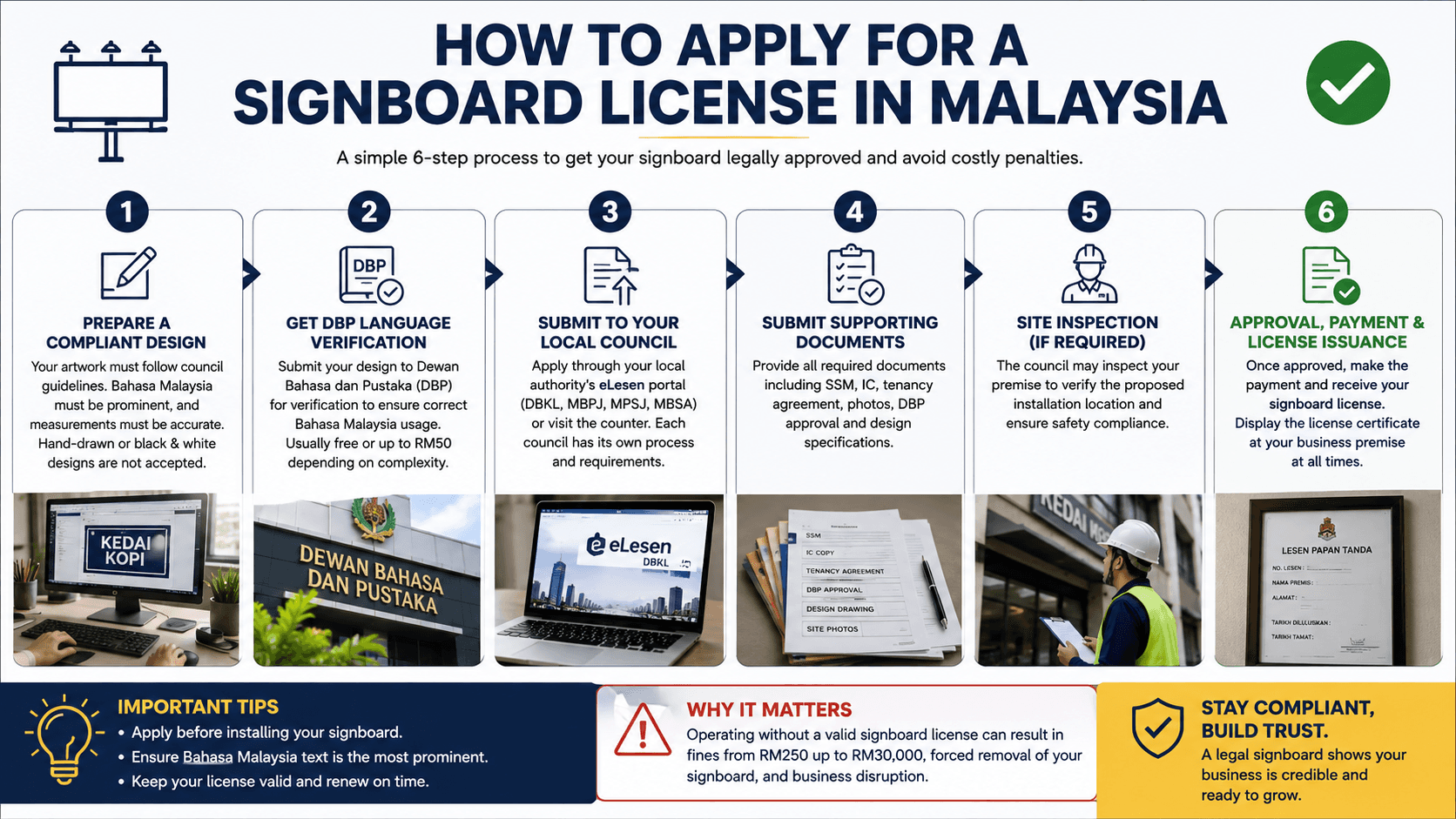
Step-by-Step Process to Apply for a Signboard License
Understanding the full process helps you avoid delays. Here is how it works in practice:
Step 1) Prepare a Compliant Design
Your artwork must follow council guidelines, including language requirements (Bahasa Malaysia must be prominent), size limitations relative to your shop frontage, and layout clarity. Hand-drawn sketches and black-and-white artwork are not accepted colored visuals are required.
Step 2) Get DBP Language Verification
Before submission to the council, your signboard design must be verified by Dewan Bahasa dan Pustaka (DBP) to confirm correct Bahasa Malaysia usage. This step is mandatory and is often the one most businesses overlook. DBP verification is usually free or may cost up to RM50 depending on the application.
Step 3) Submit Application to Your Local Council
Applications go to the authority that governs your area. The main councils are:
- DBKL — for businesses in Kuala Lumpur (via eLesen portal: elesen.dbkl.gov.my)
- MBPJ — for Petaling Jaya (via eLesen MBPJ)
- MPSJ — for Subang Jaya
- MBSA — for Shah Alam
Each council has its own portal, process, and requirements. Applying to the wrong council or following the wrong guidelines is a surprisingly common mistake. See how DBKL and Selangor council rules compare
Step 4) Submit Supporting Documents
Incomplete documentation is the most common reason for delays. See the full document checklist in the next section.
Step 5) Site Inspection (if required)
Some councils may conduct a physical inspection to verify signboard placement and structural safety before granting approval.
Step 6) Approval, Payment, and License Issuance
Once approved, you pay the applicable fee and receive your license. The signboard license certificate must be displayed at your premises at all times.
Documents Required for Signboard License Application
Requirements may vary slightly by council, but most applications require:
- Company/business registration documents (SSM Form 9 and 49, or Form D)
- Copy of applicant's IC or passport
- Colored signboard artwork with dimensions clearly stated
- Copy of DBKL/local council business premise license (if already held)
- Colored photographs of the proposed installation location
- Tenancy agreement or property ownership proof
- Letter of consent from building owner (if applicable)
- DBP-verified language artwork
- For large signboards exceeding 40ft length and 4ft width on 4th floor and above: Public Liability Insurance and a certified structural plan from a registered engineer
From our experience working with businesses across KL and Selangor, the most common delays happen when documents are incomplete, the artwork is submitted in black and white, or the DBP step is skipped entirely.
Signboard License Cost in Malaysia — Full Breakdown
Most online sources are vague about this. Here is the clear picture.
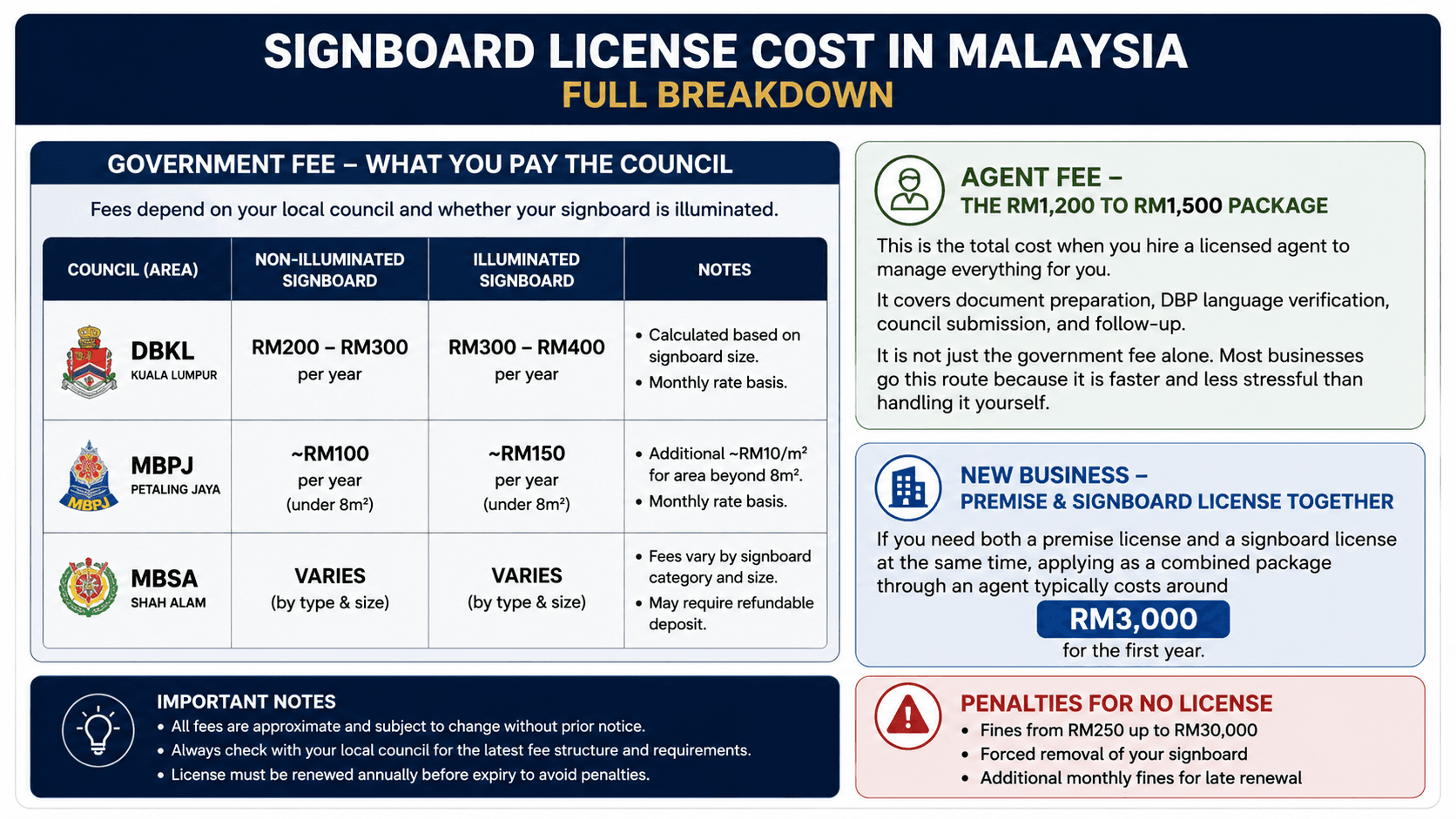
There are two types of costs involved: the government fee you pay directly to your local council, and the agent fee if you hire someone to handle the application for you.
Government Fee — What You Pay the Council
The fee depends on which council covers your area and whether your signboard has lighting or not.
For businesses in Kuala Lumpur under DBKL, a non-illuminated signboard costs around RM200 to RM300 per year. If your sign has lighting such as LED or neon, expect to pay around RM300 to RM400 per year. The exact amount is calculated based on your signboard size.
For businesses in Petaling Jaya under MBPJ, fees are lower. A non-illuminated sign under 8m² costs around RM100 per year. An illuminated sign of the same size is around RM150 per year. Signs larger than 8m² carry an extra charge of about RM10 per m² on top.
For Shah Alam under MBSA, fees vary by signboard type and size. MBSA may also require a refundable deposit depending on your signboard category.
Businesses operating across Kuala Lumpur and Selangor should also understand how DBKL, MBPJ, MBSJ and MBSA requirements differ in practice. Read our detailed comparison guide on signboard license KL vs Selangor rules, fees and council requirements.
Agent Fee — The RM1,200 to RM1,500 Package
This is the total cost when you hire a licensed agent to manage everything for you. It covers document preparation, DBP language verification, council submission, and follow-up. It is not just the government fee alone. Most businesses go this route because it is faster and less stressful than handling it yourself.
New Business — Premise and Signboard License Together
If you need both a premise license and a signboard license at the same time, applying as a combined package through an agent typically costs around RM3,000 for the first year.
Penalties for No License
Operating without a valid signboard license can result in fines from RM250 up to RM30,000, forced removal of your signboard, and additional monthly fines for late renewal.
How Long Does the Process Take
With complete, correct documentation, the process typically takes 3 to 5 working days. Here is a realistic breakdown:
- Preparing documents: 1 day
- DBP language verification: 1–2 days
- Council processing: 2–4 working days
Delays happen almost always for the same reasons — incorrect or missing documents, non-compliant artwork, or skipping the DBP step. We have seen businesses wait weeks for approval simply because one document was submitted in the wrong format.
Signboard License Renewal in Malaysia
Your lesen papan tanda is valid for one year and must be renewed before it expires. Late renewal at MBPJ carries a penalty of RM300 per month — an avoidable cost.
Renewal process:
Log in to your council's eLesen portal (elesen.dbkl.gov.my for KL businesses)
Submit previous year's license, updated SSM documents, and current photos of the signboard
Pay the annual renewal fee
If your signboard design, size, or lighting has changed since the last approval, you cannot use the simplified renewal process. Any changes require a fresh application with new DBP verification. We have seen businesses unknowingly void their license by changing their sign color or logo without informing the council.
Common Mistakes That Cause Delays and Rejections
Over 13 years working with businesses in KL and Selangor, these are the mistakes we see most often:
Incomplete documentation — Missing one file causes the entire application to be put on hold. Build a complete checklist before submitting.
Non-compliant design — Incorrect Bahasa Malaysia sizing, black-and-white artwork, or a design that covers windows or building facades will be rejected outright.
Installing before approval — This is a serious offense. Installing first and applying later can result in forced removal and fines even if the design would have been approved.
Ignoring council-specific rules — DBKL rules are not the same as MBPJ rules. Applying the wrong guidelines to your council is a common and avoidable error.
Changing the approved design during installation — Any modification to font, color, size, or layout after approval requires new approval. Even small changes count.
For a complete breakdown of every rejection reason and how to fix each one, read our guide on why signboard license applications get rejected in Malaysia.
How HC Creative Hub Helps You
Designing a compliant signboard is not just about aesthetics. It is about knowing the exact requirements before the design is finalised.
At HC Creative Hub the signage company, we design every signboard with compliance in mind from the first conversation. We understand what DBKL expects, what MBPJ's eLesen process requires, and what DBP needs to verify. When we worked on the signage project for University of Malaya, precision in documentation and design compliance was as important as the visual result.
Whether you need a 3D frontlit sign for your shop or LED neon signage for your cafe, we guide you through the full process — from design to approval to installation — so you do not have to figure it out alone.
Planning a new signboard? Chat with our team on WhatsApp for fast, practical advice on your specific situation.
Conclusion
Getting a signboard license (lesen papan tanda) in Malaysia is straightforward when you know the process. The most common problems are not complicated: they are usually a missing document, an unchecked design detail, or a skipped DBP step.
A properly approved signboard does more than keep you legally compliant. It signals to your customers that your business is established, credible, and here to stay.
If you want to explore what type of signboard suits your business and budget, browse our signboard services or contact our team for a free consultation.
Ready to get started? we will guide you from design to approval or you can also view our blogs for more information.
Frequently Asked Questions
How much does a signboard license cost in Malaysia?
Government fees depend on your council. DBKL charges roughly RM200–400 per year depending on sign size and lighting, while MBPJ charges RM100–150 per year for standard signs under 8m². If you engage an agent to handle the full application process, the total package including agent fees typically comes to RM1,200–RM1,500.
Is a signboard license mandatory in Malaysia?
Yes. Every physical business in Malaysia is legally required to obtain a signboard license before installing any signage. Operating without one can result in fines up to RM30,000 and forced removal.
How long does it take to get a signboard license?
With complete and correct documents, approximately 3 to 5 working days. Delays are almost always caused by incomplete documentation or non-compliant artwork.
Can I install a signboard before getting approval?
No. Installing before approval is a legal offense and can result in fines of RM250–RM2,000 or forced removal, even if your design would have been approved.
Do I need to renew my signboard license every year?
Yes. The lesen papan tanda is valid for one year and must be renewed annually before expiry. Late renewal carries penalty charges that vary by council.
What is the difference between a premise license and a signboard license?
A premise license (lesen premis) permits you to operate a business at a location. A signboard license (lesen papan tanda) specifically permits you to display signage outside that premises. Both are required separately, though they can be applied for together through some councils.
What is a PBT license in Malaysia?
PBT stands for Pihak Berkuasa Tempatan, which means local authority. DBKL, MBPJ, MPSJ, and MBSA are all examples of PBT. When people refer to a PBT license, they usually mean any business or signboard license issued by the local authority governing their area. Your signboard license is essentially a PBT-issued permit — the specific council depends on where your business is located.
Apakah dokumen yang diperlukan untuk memohon lesen papan tanda?
Dokumen asas yang diperlukan termasuk pendaftaran syarikat (SSM), salinan IC, rekabentuk papan tanda berwarna yang telah disahkan DBP, perjanjian sewa, dan gambar lokasi pemasangan. Senarai lengkap mungkin berbeza mengikut pihak berkuasa tempatan anda.