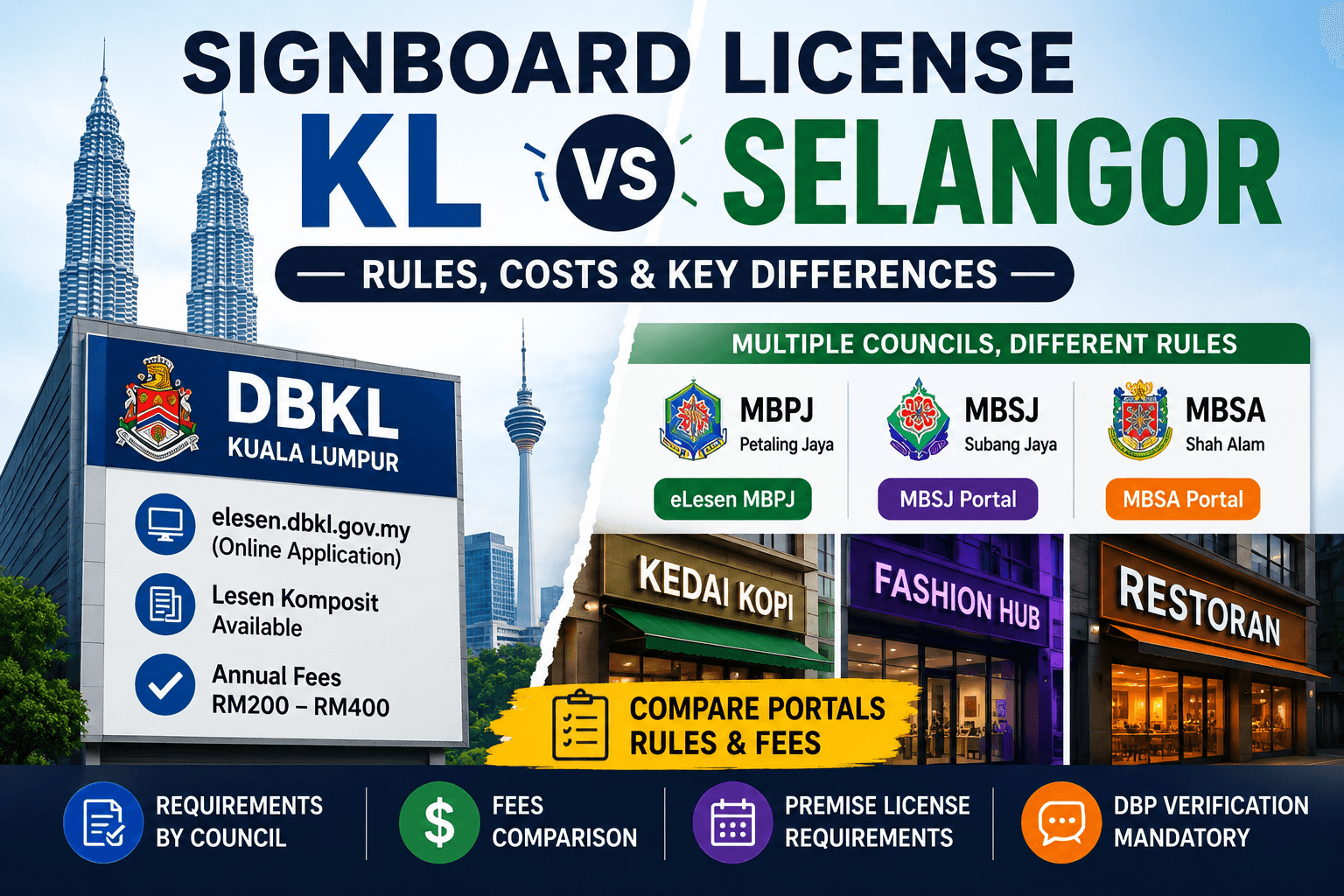
Signboard License KL vs Selangor Rules Complete Guide for Businesses
April 7, 2026
Understanding the Difference Between DBKL and Selangor Signboard Rules
If your business is in Kuala Lumpur, your signboard license comes from DBKL. If you are in Petaling Jaya, Subang Jaya, or Shah Alam, a completely different council handles your application.
Many business owners find this out after they have already prepared the wrong documents or submitted to the wrong authority. Getting this right from the start saves you weeks of back and forth.
This guide covers the real differences between KL and Selangor for signboard licensing — the authority, the process, the fees, and the design rules. If you want to understand the full licensing process first, start with our complete guide on signboard license Malaysia and come back here for the council-by-council breakdown.
Why KL and Selangor Work Differently
Kuala Lumpur is a federal territory. One authority DBKL, Dewan Bandaraya Kuala Lumpur handles all signboard licensing across the city under the Advertisement Federal Territories By-Laws 1982.
Selangor is a state with multiple local councils. Your council depends entirely on your address. Petaling Jaya falls under MBPJ. Subang Jaya is governed by MBSJ. Shah Alam is under MBSA. Each council has its own application process, its own portal, and its own fee structure.
This is why preparing documents based on the wrong authority causes delays. Before anything else, confirm which council covers your exact address. The boundary between DBKL and MBPJ runs through areas many people loosely call KL. Some Ampang addresses are DBKL, and some areas that feel like KL are technically MBPJ. Check first, then prepare.
Signboard License in Kuala Lumpur — DBKL
DBKL governs all business signage in Kuala Lumpur — shopfront signs, 3D frontlit signboards, LED lightboxes, neon signs, and any outdoor-facing display on a building.
Applications go through elesen.dbkl.gov.my. Most standard applications are fully online.
Something many business owners do not know about is the Lesen Komposit — Composite License. This bundles your premise license and signboard license into one combined application. For new businesses opening in KL, this is usually the faster and cleaner route. It keeps your compliance in order from day one instead of managing two separate applications.
Key DBKL Signboard Rules
Your sign must align with your unit and cannot extend beyond your shop width. Structural signboards above a certain size need a certified engineer's plan. Flashing or animated lighting is not permitted.
Bahasa Malaysia must appear on all business signboards. If other languages are included, the Malay text must be at least 30 percent larger. Before submitting to DBKL, your design goes through Dewan Bahasa dan Pustaka (DBP) for language verification. This takes 1 to 2 days and costs around RM50. It is mandatory and skipping it causes rejection.
DBKL fees
Annual fees for a standard premise signboard range from RM200 to RM300 for non-illuminated signs and RM300 to RM400 for illuminated ones such as LED lightboxes and 3D frontlit signs. Renewal is due annually, and DBKL allows you to renew up to 60 days before expiry. Operating without a valid license can result in fines up to RM30,000.
Signboard License in Selangor — MBPJ, MBSJ and MBSA
Petaling Jaya — MBPJ
Petaling Jaya businesses including Damansara, Kelana Jaya and Bandar Utama areas apply through the eLesen MBPJ portal.
The most important thing about MBPJ — your premise license must be active before your signboard application can be approved. MBPJ treats them as connected. Submit a signboard application without a premise license and it will not move forward.
Design must be submitted in colour. Black and white artwork is rejected. The same language compliance verification applies before submission. Signboards cannot cover windows or extend beyond the building boundary. Flashing lights are not allowed under MBPJ Advertisement By-Law 2007.
MBPJ fees
Non-illuminated signs up to 8 square metres cost RM100 per year. Illuminated signs of the same size cost RM150 per year. Signs above 8 square metres carry an additional charge of around RM10 per square metre. A refundable deposit is required at the time of application. Late renewal carries a RM300 per month penalty.
Subang Jaya — MBSJ
Subang Jaya became a full bandaraya in 2019 and now operates under MBSJ with its own Advertisement Bylaws 2007. This covers USJ, Putra Heights and Puchong areas within MBSJ boundaries.
MBSJ has detailed planning guidelines for outdoor advertising that cover LED signs, lightboxes and size control. Signboards must be fixed to the wall or beam of the building. Freestanding signs need a separate permit. MBSJ sets projection limits from the building boundary, meaning your sign cannot extend beyond a certain depth from the wall.
Before finalising your artwork dimensions, it also helps to check our complete signboard size guidelines in Malaysia to avoid sizing and projection issues during approval.
Premise license approval is also required before the signboard application can proceed, similar to MBPJ. Fees follow a similar tier structure. Confirm current rates directly with MBSJ as they are updated periodically.
Shah Alam — MBSA
Shah Alam and surrounding areas fall under MBSA, Majlis Bandaraya Shah Alam. MBSA fees are generally higher than MBPJ. Annual fees for smaller retail premises typically start from RM500 and go higher depending on signboard size and category. A refundable deposit may also be required.
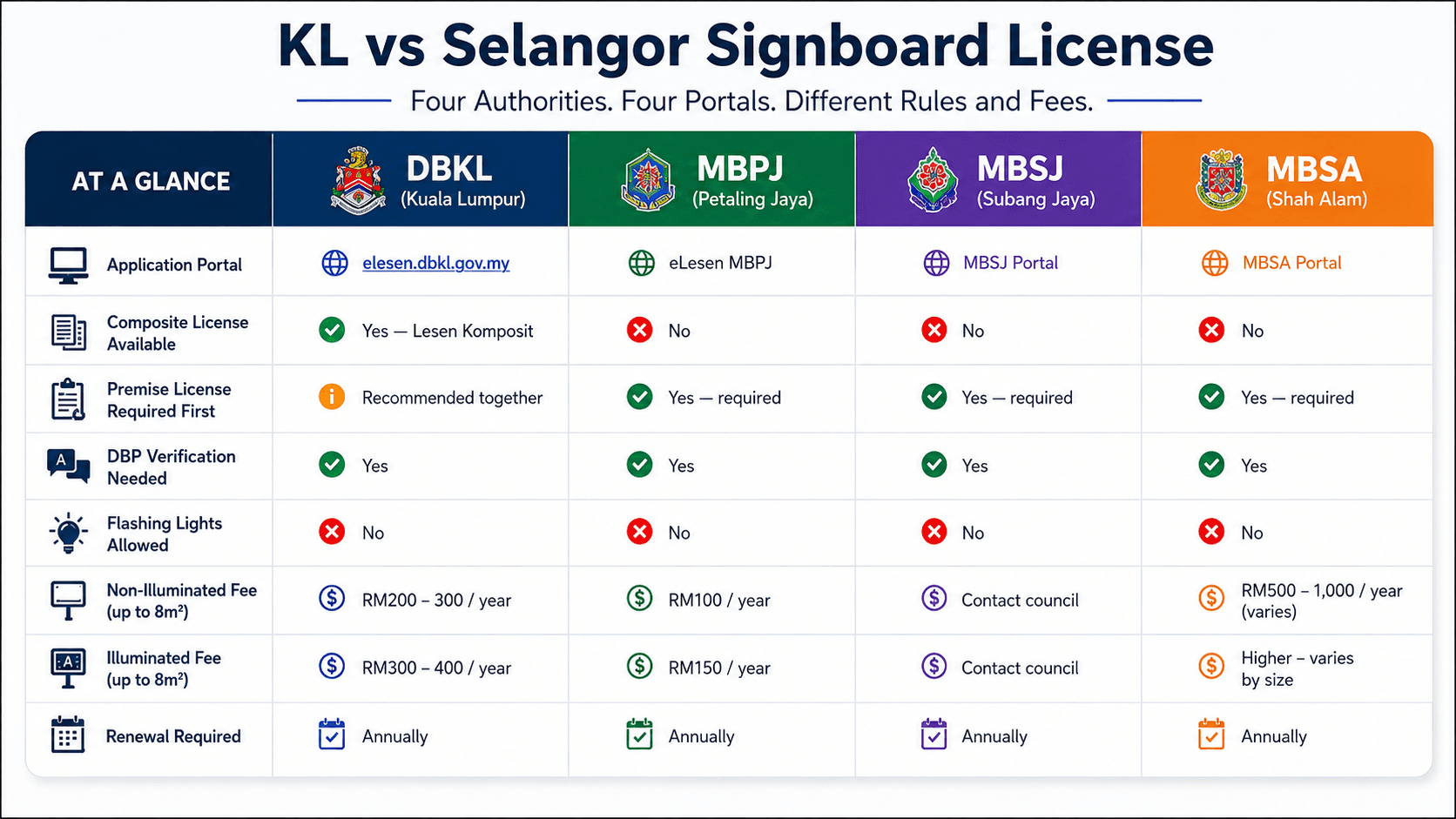
KL vs Selangor — Clear Comparison
Governing authority KL uses DBKL under the federal territory law. Selangor uses separate councils — MBPJ, MBSJ, MBSA — each with their own bylaws and processes.
Application portal DBKL uses elesen.dbkl.gov.my. MBPJ, MBSJ and MBSA each have their own separate online portals.
Composite license DBKL offers the Lesen Komposit which bundles premise and signboard licenses. Not available in any Selangor council. In MBPJ and MBSJ, the premise license must come first.
Annual fees DBKL non-illuminated: RM200 to RM300 per year. DBKL illuminated: RM300 to RM400 per year. MBPJ non-illuminated up to 8m²: RM100 per year. MBPJ illuminated up to 8m²: RM150 per year. MBSA: RM500 and above depending on size.
DBP verification Required in all areas before submission.
Flashing lights Not permitted under any council.
Renewal Annual across all councils. MBPJ late renewal penalty is RM300 per month.
Rules That Apply Everywhere
Whether your business is in KL or Selangor, these apply across all councils without exception.
Bahasa Melayu must be on all business signboards with text at least 30 percent larger than any other language. DBP verification before submission is non-negotiable everywhere. No installation before written approval — doing this risks fines and complicates your actual application. All lesen papan tanda are valid for one year and must be renewed on time.
What Actually Causes Delays
Most delays happen because businesses follow the wrong council requirements or skip small compliance steps during submission.
Businesses prepare documents for the wrong council because they assumed their area follows DBKL rules when their address is actually MBPJ. Artwork gets submitted in black and white when colour is required. DBP verification gets skipped because nobody mentioned it was mandatory. The installed sign does not match the approved artwork because a small logo change was made during production.
These are the patterns we see repeatedly. None of them are difficult to avoid when you know what each council actually requires.
For a full breakdown of every rejection reason and how to fix each one, read our guide on why signboard license applications get rejected in Malaysia.
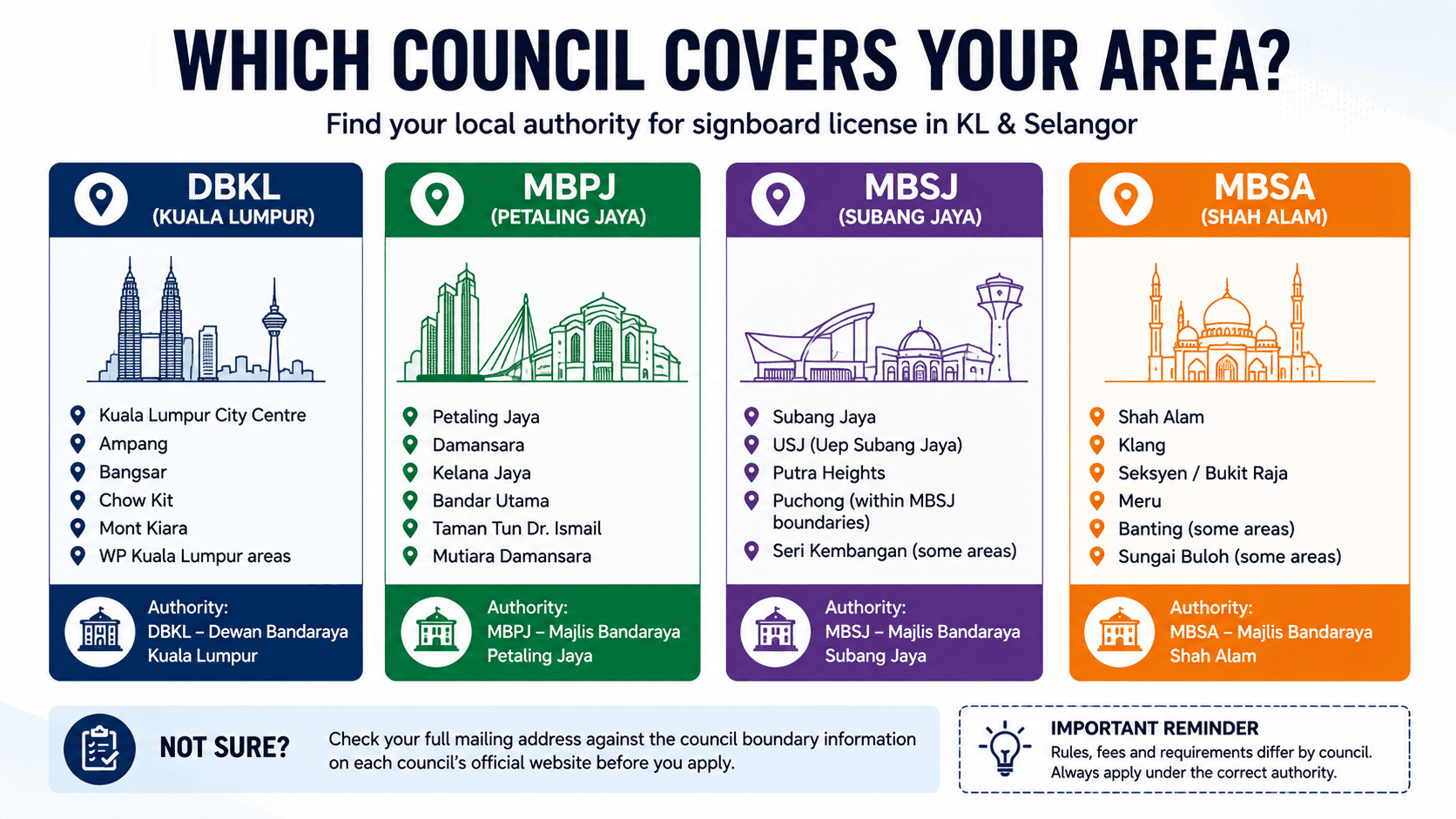
Which Council Covers Your Area
This is the first question to answer before anything else.
Kuala Lumpur city, Ampang, Bangsar, Chow Kit, Mont Kiara and WP Kuala Lumpur areas fall under DBKL. Petaling Jaya, Damansara, Kelana Jaya and Bandar Utama fall under MBPJ. Subang Jaya, USJ, Putra Heights and Puchong areas within MBSJ boundaries fall under MBSJ. Shah Alam, Klang and surrounding areas fall under MBSA.
If you are not sure, check your full mailing address against the council boundary information on each council's official website before you prepare anything.
How HC Creative Hub Handles This
Confirming the council area is the first thing we do before any signboard design begins. It affects everything — the documents needed, the portal used, the timeline, and the design compliance requirements.
When we worked on the signage project for University of Malaya, documentation and placement compliance was planned from the first conversation — not figured out after the design was done. The same approach applies whether we are working on a 3D frontlit signboard for a retail shop in Petaling Jaya under MBPJ or LED neon signage for a cafe in Ampang under DBKL.
Over 13 years and more than 1,000 projects across Kuala Lumpur and Selangor, the businesses that move fastest through licensing are the ones that start with the right information for their specific council — not general advice.
If you want to make sure your signboard project goes smoothly from design to approval, browse our signboard services or chat with our team on WhatsApp before you finalise anything.
FAQs
Is the signboard license process the same in KL and Selangor?
No. KL uses DBKL under the federal territory law. Selangor has multiple councils — MBPJ, MBSJ, MBSA — each with their own process, portal, and fees. The core requirements are similar but where you apply, what you pay and what documents you need differs by council.
What is the Lesen Komposit and is it available in Selangor?
The Lesen Komposit is a DBKL option that combines your premise license and signboard license into one application. It is only available in Kuala Lumpur. In Selangor, MBPJ and MBSJ require your premise license to be active before the signboard application can be approved — there is no combined option.
How much does an MBPJ signboard license cost compared to DBKL?
MBPJ fees are lower. A non-illuminated sign under 8m² costs RM100 per year at MBPJ compared to RM200 to RM300 at DBKL. Illuminated signs are RM150 at MBPJ versus RM300 to RM400 at DBKL. Both require annual renewal.
Do I need DBP approval in both KL and Selangor?
Yes. DBP — Dewan Bahasa dan Pustaka — verification is required in all council areas before you submit your application. It confirms your Bahasa Malaysia text is correct and properly prominent. It usually takes 1 to 2 days.
What happens if I install without approval?
Fines ranging from RM250 to RM5,000 and forced removal. This applies in KL and all Selangor councils. Always wait for written approval before installation.
Apakah perbezaan utama antara lesen DBKL dan MBPJ untuk papan tanda?
DBKL mengurus lesen papan tanda di Kuala Lumpur di bawah undang-undang Wilayah Persekutuan dan menawarkan Lesen Komposit yang menggabungkan lesen premis dan papan tanda dalam satu permohonan. MBPJ pula mentadbir perniagaan di Petaling Jaya dengan undang-undang kecilnya sendiri dan lesen premis perlu diperoleh dahulu sebelum permohonan papan tanda boleh diluluskan. Yuran DBKL juga lebih tinggi berbanding MBPJ untuk saiz yang sama.