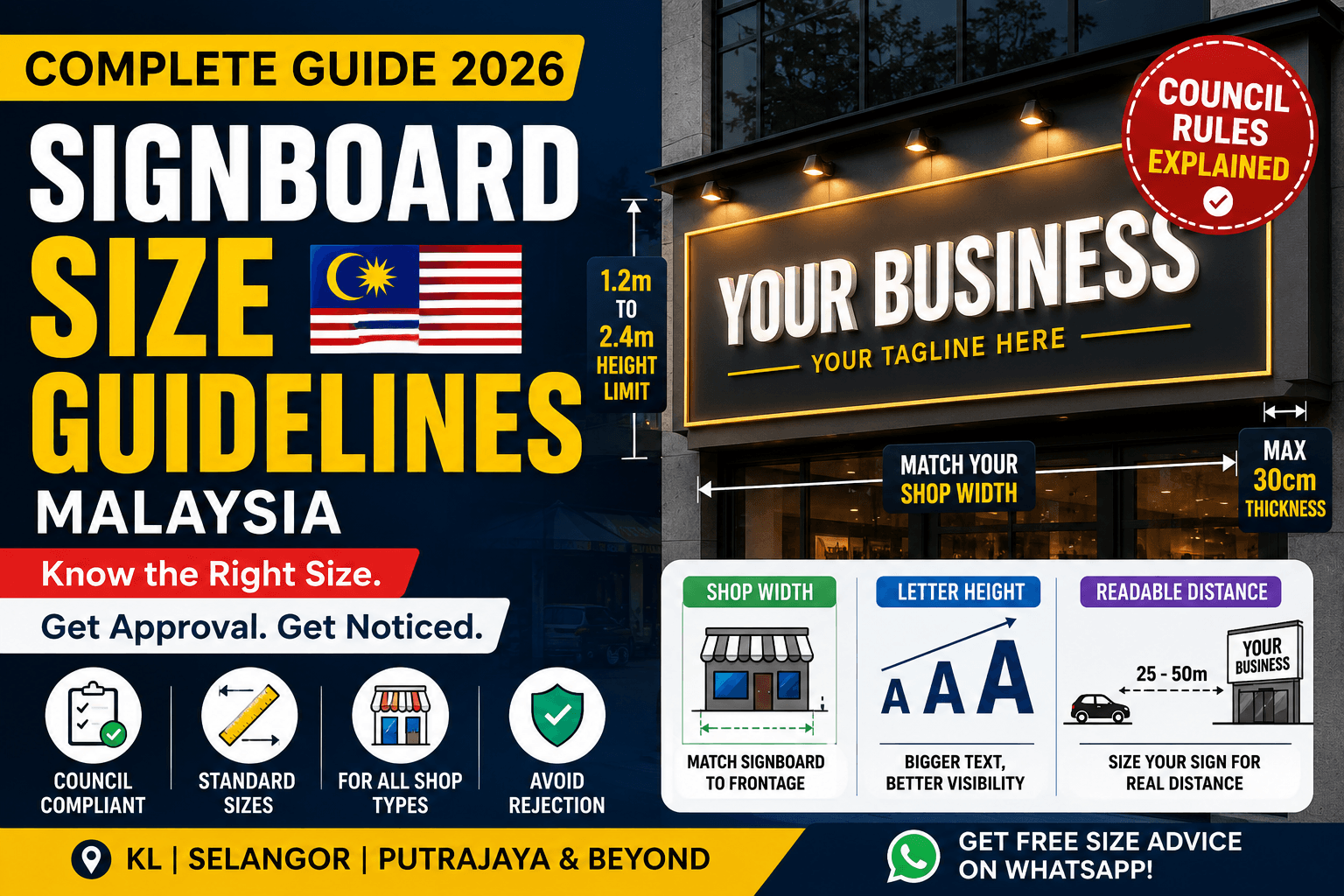
Signboard Size Guidelines Malaysia Complete Guide for Businesses
June 5, 2026
Many Malaysian businesses only think about sizing after the design is done. That usually leads to approval problems, poor visibility, or unnecessary production costs. That is usually where problems start, either the signboard is too large for the shop lot and gets flagged by the council, or it is too small and customers simply do not notice it from the road.
In this guide, you will find the actual size rules that councils follow, a simple way to figure out the right dimensions for your specific shop, and how different signage types are sized differently.
If you are also planning to apply for your signboard license, our complete guide on signboard license Malaysia covers the full approval process before you start.
Why Signboard Size Matters More Than Most People Think
For many shops, the signboard is the first thing customers notice before they even walk inside. Before a customer reads your name or sees your logo, they see the size and shape of your sign. But beyond branding, size is a compliance issue.
Approval depends on size compliance
Local councils like DBKL and MBPJ check your signboard dimensions as part of the license review. If your sign exceeds the allowed limits, does not align with your building frontage, or blocks a neighbour's unit, your application gets rejected — regardless of how good the design looks.
Visibility depends on proportion
A signboard that is too small for a busy roadside location goes unnoticed. One that is too large for a quiet taman perniagaan looks out of place. The goal is to stay visible without making the sign look oversized or causing approval issues.
If your shop faces a fast-moving road, a small signboard may not be readable in time. On the other hand, an oversized sign inside a mall or quieter commercial row can feel too aggressive for the space.
Cost and long-term performance
Bigger signboards cost more in materials, installation, and maintenance. Getting the size wrong early means redesigning, reproducing, and resubmitting — all avoidable costs.
Standard Signboard Size Guidelines in Malaysia
There is no single fixed size that applies to every business. But there are common standards used across KL and Selangor that most council approvals are built around.
Typical shopfront sizes
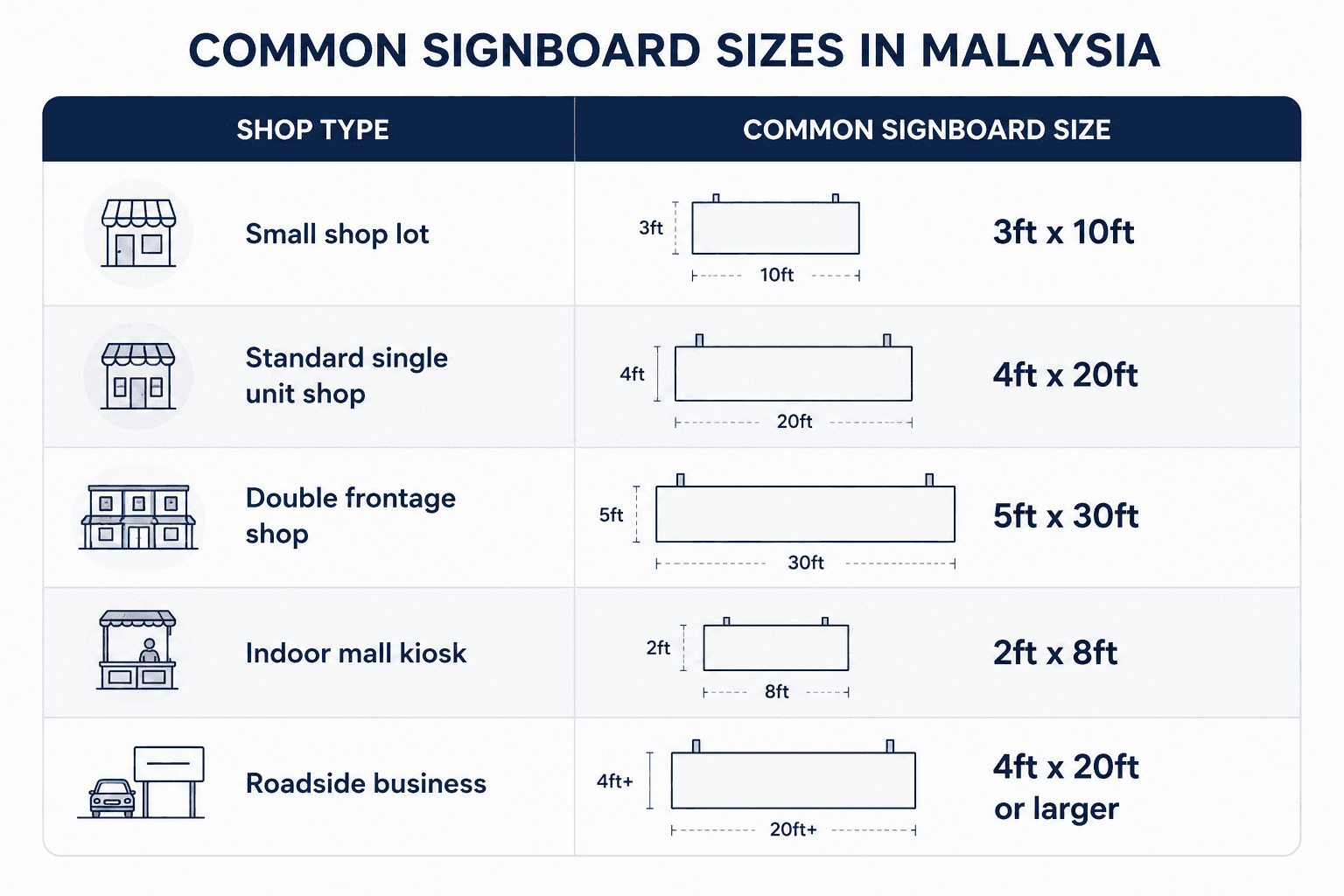
The most commonly used size across Malaysian shopfronts is 4ft x 20ft. This fits a typical single unit shop lot comfortably. Smaller shops usually go with 3ft x 10ft, and wider lots sometimes go up to 5ft x 30ft — but that depends entirely on your frontage width.
In most cases, councils expect the signboard width to stay within the shop lot frontage without crossing neighbouring boundaries.
If you want practical dimensions for specific signage types like acrylic signs, lightboxes, billboards, or LED neon, our guide on standard signboard sizes in Malaysia by type explains the common dimensions used for each format.
Height limits
Most councils allow signboard height between 1.2 metres and 2.4 metres. Going beyond 2.4 metres usually needs special approval or may not be permitted depending on your building type.
Width and buffer space
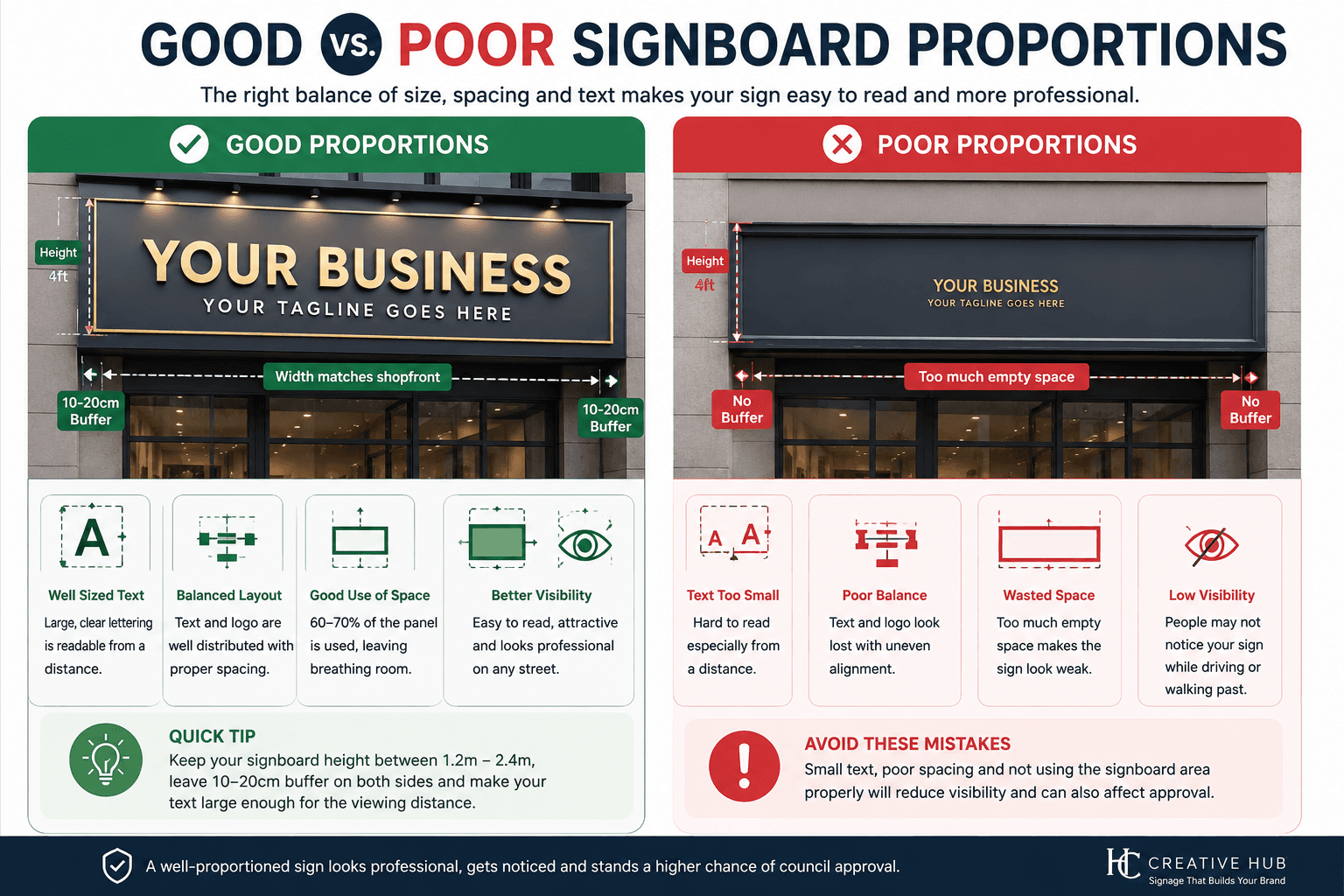
Your signboard should not touch the edge of your shop unit. Leave around 10 to 20 centimetres on both sides. This spacing improves visual balance and helps avoid boundary-related approval issues.
Thickness limits
For lightboxes, 3D frontlit signs, and backlit signage, the maximum thickness is around 30 centimetres from the wall. This is a safety rule. A sign that protrudes too much from the wall becomes a structural concern during council inspection.
Facade coverage
Your signboard should not cover more than around 30 percent of the building facade. This is why very large signs on multi-storey buildings get flagged — even if the width looks fine, the total visual coverage matters separately.
Vertical signs
DBKL specifically allows double-sided vertical signboards up to 7 feet high and 3 feet wide — but only for ground floor premises. If your shop is on a higher floor, vertical signs go through a separate review process.
Higher floor rules
For signboards on the 5th floor and above, a structural engineer's report is required. For horizontal signboards above 40 feet in length, public liability insurance is also needed. Most standard retail shops will not hit these requirements, but offices and commercial tower tenants should know this.
For how DBKL and Selangor councils handle these rules differently, our signboard license KL vs Selangor guide has the full council-by-council breakdown.
Signboard Size Based on Location
The right size also depends on where your shop is and who your customers are.
Roadside shops on busy roads
If your shop faces fast-moving traffic, your highway signboard needs to be larger and your lettering taller. For shops on main roads in areas like Ampang, Pandan Indah, or along major Selangor roads, a 4ft x 20ft signboard with properly sized text is usually the minimum for real visibility.
Shops in taman perniagaan or commercial rows
In quieter commercial areas where customers are walking past or parking nearby, a 3ft x 10ft to 4ft x 12ft signboard is often enough. The viewing distance is shorter, so a smaller sign with clean design still performs well.
Shophouses and older commercial areas
In areas with shophouse architecture — parts of Ampang, older KL commercial streets, some Selangor towns — councils are stricter about signboard size to maintain the visual character of the area. Always check your specific council rules before finalising dimensions here.
Signboard Size by Type of Signage
Different signage types have different sizing logic. Here is a practical breakdown.
3D Frontlit Signboard
For a 3D frontlit sign — the most common type on Malaysian shopfronts — the panel size follows your shop width rules. Letter height for the main text is typically between 20 to 50 centimetres. For roadside shops, 50 centimetres or taller works better for readability from a moving vehicle.
You can see how this works in practice by looking at our 3D frontlit signboard projects — dimensions are always planned around the actual shopfront before design starts.
LED Lightbox and Fabric Lightbox
Lightbox signage typically spans the full usable shop width with a height of 3 to 5 feet. Maximum thickness is 30 centimetres. Slim lightboxes used indoors can be thinner. For a 20-foot frontage, a 4ft x 18ft lightbox with 20 centimetre buffer on each side is a safe and common choice.
Our LED lightbox signage service covers fabric, acrylic, slim, and ceiling lightbox options depending on your shop setting.
LED Neon Signboard
Neon signs are more flexible because they are often used as secondary branding or decorative elements rather than the primary shopfront sign. Indoor neon has fewer restrictions. Outdoor neon still follows the standard height and thickness rules. For a storefront, common sizes range from 2ft x 4ft for smaller decorative pieces to 4ft x 8ft for a main display.
When Bayleaf Kitchen wanted a neon sign that matched the warmth of their F&B space, the sizing was decided based on the wall area and the viewing distance from inside the restaurant — not just what looked good in a mockup. You can see the result on our Bayleaf Kitchen project page.
Billboard and Outdoor Banner
Billboards fall under a separate category and require their own permit. Sizes vary widely — from 10ft x 20ft for smaller roadside placements to larger formats for highway-facing locations. The approval process is more complex and involves structural and safety reviews separately from a standard premise signboard. Our ZigZag billboard and outdoor banner service covers large-format outdoor advertising across KL and Selangor.
3D Non-Light Acrylic Signs
Non-illuminated acrylic signs — papan tanda tanpa lampu — follow the same basic size rules as frontlit signs. Because there is no internal lighting, councils sometimes give slightly more flexibility on placement, but width and height rules remain the same.
For sizes by each signage type in more detail, our separate guide on standard signboard sizes in Malaysia by type breaks this down further.
Viewing Distance — The Factor Most People Ignore
One of the most overlooked parts of signboard planning is the distance your customers will actually read your sign from.
A practical way to think about readability:
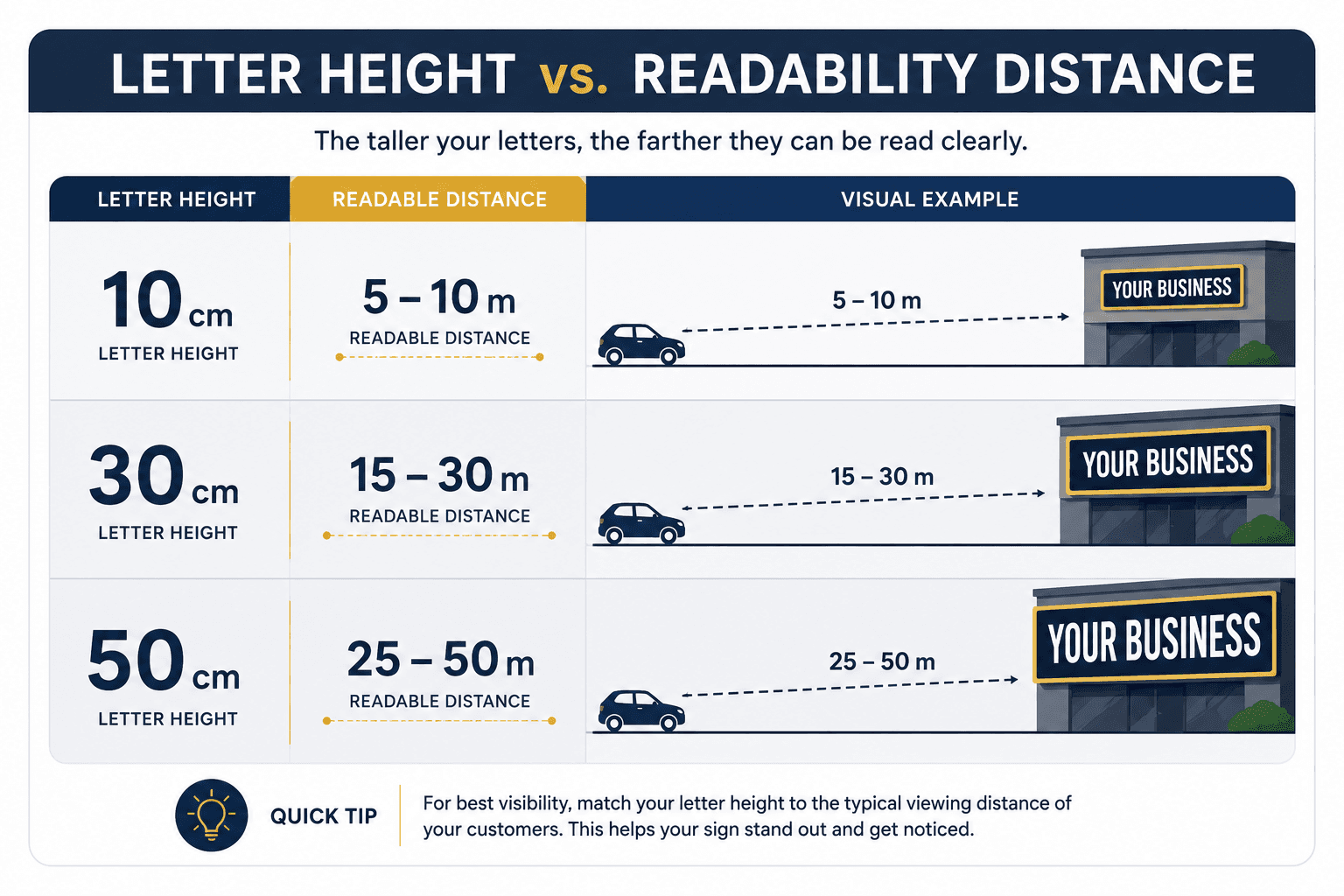
10cm letter height — readable from around 5 to 10 metres 30cm letter height — readable from around 15 to 30 metres 50cm letter height — readable from around 25 to 50 metres
If your shop faces a busy road where cars pass at 50 to 60 km/h, your letters need to be large enough to read in under two seconds. A 20cm letter on a 3ft board will not do that job. A 50cm letter on a 4ft board will.
Visibility planning should consider traffic speed, viewing distance, and the angle customers approach from before finalising dimensions not just the board dimensions.
Proportion Guide — Size Alone Is Not Enough
A common mistake is ordering the right board size but filling it incorrectly.
A 4ft x 20ft board with tiny 8 centimetre letters looks empty and reads poorly from a distance. A 3ft x 10ft board with well-proportioned 35 centimetre letters can actually perform better for a quieter location.
A length-to-height ratio of 3:1 or 4:1 works well on most Malaysian shopfronts. For a board that is 12 feet wide, a height of 3 to 4 feet gives a balanced look that also sits within most council height limits.
Text should occupy roughly 60 to 70 percent of the panel area. Leaving enough negative space around the text improves readability from a distance.
Material and How It Affects Sizing
The material you choose affects how the sizing works structurally — not just visually.
Acrylic panels for 3D frontlit and lightbox signs are typically 3mm to 5mm thick for the face. The box depth adds to the total thickness, which must stay within the 30 centimetre council limit.
Metal signs aluminium composite and EG sheet are heavier and need stronger wall fixings for larger sizes. For a 4ft x 20ft metal signboard on an older shophouse wall, the mounting structure needs to be checked properly.
PVC board is usually better for smaller indoor signage rather than large outdoor installations.
Material selection should be planned together with signboard design and dimensions because larger formats place different structural loads on the wall and frame. Size and material need to be decided together.
Common Size Mistakes That Cause Rejection
Going wider than your shop unit Even by a few centimetres, extending into the neighbouring unit causes rejection at most councils.
Ignoring the buffer space A signboard that touches the edge of your shop boundary looks rushed and often gets flagged during review.
Too thick a sign body Especially with 3D letters and lightboxes — if the box depth goes past 30 centimetres, councils can reject on safety grounds.
Wrong letter size for viewing distance A board that looks big enough in the design file can still be unreadable from where your customers actually stand or drive.
Ignoring floor rules Businesses in upper-floor offices or commercial towers often skip the structural requirements that apply above ground level.
For the full list of what causes applications to fail, our guide on why signboard license gets rejected in Malaysia goes through every common reason and how to fix it.
How to Choose the Right Size for Your Shop
This is the simple method we follow at HC Creative Hub before recommending any signboard to a client.
Step 1) Measure your shopfront Width, height, and the exact wall area where the sign will go.
Step 2) Identify your audience Walking traffic or vehicle traffic? How fast are they moving? How close do they get to your shop?
Step 3) Choose your signage type 3D frontlit, LED lightbox, neon, or non-light — each has different sizing logic as covered above.
Step 4) Follow your council's guidelines DBKL, MBPJ, MBSJ, MBSA — each has slightly different rules. Confirm the specific rules for your area before finalising anything.
Step 5) Work with someone who knows both design and compliance Over 13 years working with businesses across KL and Selangor. In most successful installations, sizing is usually planned before artwork and production begin.
Working with an experienced signboard company in Malaysia helps avoid sizing mistakes that often lead to redesign costs or council approval delays.
Not sure what size actually fits your shopfront? Send us your shop width and shop photo on WhatsApp and our team can suggest a practical signboard size before you finalise the artwork or production.
Pre-Installation Checklist
Before any signboard goes into production, run through this:
- Shopfront width measured and confirmed
- Buffer space of 10 to 20cm planned on both sides
- Letter sizes tested against actual viewing distance
- Thickness within 30cm for any 3D or lightbox sign
- Council-specific rules confirmed for your area
- Artwork in colour and ready for DBP verification
- Building owner consent in hand if you are a tenant
FAQ
What is the standard signboard size in Malaysia?
The most common size is 4ft x 20ft for a standard single-unit shop. But the right size really depends on your shopfront width, your location, and what type of sign you are putting up. A shop with a 15-foot frontage would normally use something smaller like 3ft x 10ft to stay proportional and get through council approval without issues.
Can I choose any size I want?
No — it has to work within your shop boundary and follow your local council's rules. You also need to think about thickness, height, and facade coverage. A signboard that looks fine visually can still fail approval if it misses any of these.
What is the maximum signboard height in Malaysia?
Most councils work within 1.2 metres to 2.4 metres for standard shopfront signboards. Going beyond that needs special approval and depends on your building type and floor level.
What is the maximum thickness allowed?
Around 30 centimetres from the wall surface. This applies to LED lightboxes, 3D frontlit signs, and backlit signs. Beyond this, structural safety concerns come up during council review.
Do I need council approval just because of signboard size?
Size is part of your overall signboard license application — it is reviewed together with your design, language compliance, and placement. If the dimensions do not meet guidelines, the whole application is affected. There is no separate "size approval" — it is all part of the same lesen papan tanda process.
Do shopping mall signboards follow the same rules?
Not always. Indoor mall signboards usually follow the mall management's own branding and sizing guidelines. However, outward-facing signage that is visible from outside may still require council approval depending on the location.
Apakah saiz signboard kedai yang biasa digunakan di Malaysia?
Saiz yang paling biasa ialah 4 kaki x 20 kaki untuk lot kedai standard. Saiz yang betul bergantung kepada lebar kedai anda — kedai yang lebih sempit perlukan saiz yang lebih kecil supaya tidak melebihi sempadan unit dan memenuhi syarat kelulusan majlis perbandaran tempatan.